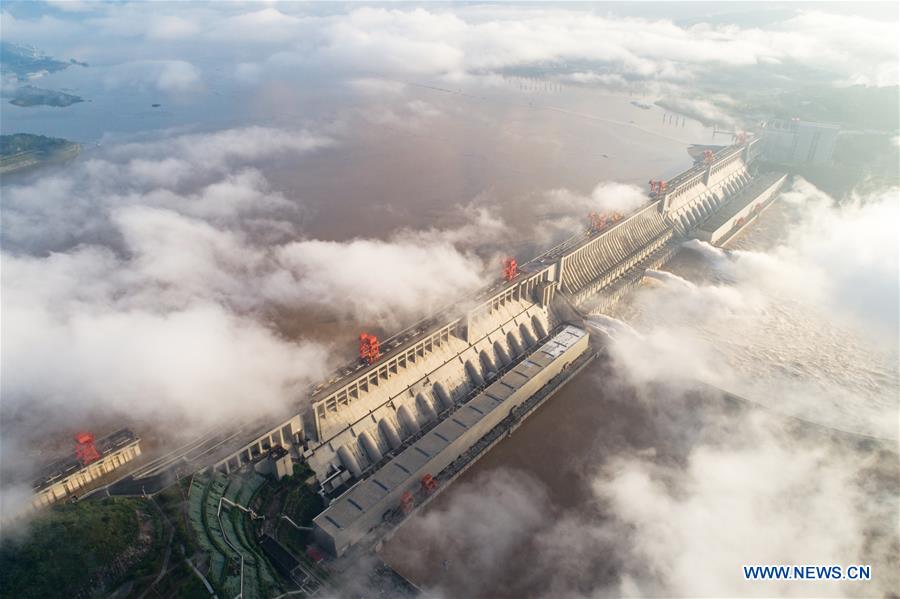
Three Gorges Dam
Introduction
The Three Gorges Dam, located in the middle section of Xiling Gorge near Sandouping town in Yichang city, Hubei province, is the world's largest hydropower project. It serves as a monumental feat in the realm of water control, electricity generation, and flood management along the Yangtze River. Conceived as a multi-functional water control system, the dam spans 2,309 meters in length and rises to a height of 185 meters.
Construction of the Three Gorges Dam marks a significant evolution in China's approach to harnessing the potential of the Yangtze River, which is the longest river in Asia. Initiated to mitigate the frequent floods that have historically plagued the river's lower reaches, the dam plays a pivotal role in flood prevention, particularly in the Jingjiang River section. This area is characterized by a high riverbed, making it susceptible to flooding along its entire 360-kilometer length. The dam regulates the flow of water from the river's upstream, preventing such water from overwhelming downstream tributaries, thereby safeguarding vast fertile plains and reducing flood risk.
Despite the dam's capacity to manage inflow from upstream, its influence on downstream tributaries is relatively limited. As such, the dam's flood prevention capabilities are concentrated more significantly on the main stream of the Yangtze River rather than its tributaries. In managing the floodwaters, the dam can restrict the discharge of water to 19,000 cubic meters per second, even when faced with an inflow ranging between 30,000 and 50,000 cubic meters per second. This strategic control has proven critical in flood management, despite raising concerns regarding water levels in the main stream.
The reservoir behind the Three Gorges Dam necessitates careful management of its water levels to prepare for seasonal flooding, maintaining an operational level below 165 meters. However, during flood seasons, the water level is allowed to rise to a maximum of 175 meters, providing space for an additional 22.1 billion cubic meters of water. In emergencies, the reservoir can hold up to 180 meters, accommodating an extra 5 billion cubic meters to ensure flood protection while maintaining operational integrity.
Beyond its primary role in flood control, the Three Gorges Dam serves as a crucial source of hydroelectric power, housing 34 turbo-generators with a combined generating capacity of 22.5 million kilowatts. Since opening for electricity generation in 2003 and subsequently to the public in 2005, the dam has become a significant tourist site, attracting over 10 million visitors in the past five years. Visitors are drawn not only to its engineering marvel but also to the rich cultural experiences offered in the region, particularly during the Dragon Boat Festival.
The dam's operational safety and structural integrity are rigorously monitored, with 12,000 instruments installed by 2013 to track parameters such as deformation, seepage, and seismic activity. Despite foreign media speculations regarding the dam's potential deformation or collapse, these claims have been refuted by the authorities, who emphasize the project's robust safety measures.
The Three Gorges Dam's significance extends beyond flood control and energy production; it is a testament to China's ambition to modernize its water conservancy infrastructure, although challenges remain. Compared to developed countries, China's water conservancy infrastructure, particularly in terms of pondage factor, still lags behind. Despite these challenges, the dam represents a substantial step towards enhanced flood management and sustainable development, with the potential for further improvement in the future.








